
July 2026 Almond Market Report

With July’s Position Report and the calendar moving to August comes the end of the 2025/26 crop year. For the crop year, California handlers received over 2.69 billion pounds, down slightly from a year before (-0.7%); had a total supply of over 3.12 billion pounds (-1.19% YoY); shipped nearly 2.63 billion pounds (-0.64% YoY); and are looking at a maximum carry forward* of 494 million pounds (-4.02% YoY). (*More on the carryforward later in the report.)
Domestic shipments slipped year over year and ended the crop year down -11.3%. Domestic volume fell below 600 million pounds marking its lowest volume in a decade surpassing the 2015/16 crop year by a mere 2 million pounds. Export markets easily made up for any slow down domestically and collectively global shipment volumes were up +3%.
During the month of July, shipment volumes were strong for both domestic and export markets. Domestic shipments were up +6.2% YoY, while export shipments were up +2.3%. Net shipment volumes topped 203.5 million pounds, comfortably the second largest July, outpaced only by the 2020/21 crop year when California was processing its largest crop on record.
Purchasing volume during July was also solid. Handlers enter the new crop year with +14.27% more pounds under contract than a year ago and -17.18% fewer pounds of uncommitted on-hand inventory. These figures are reflective of strong monthly purchasing that continued in July with over 235 million pounds being transacted. This figure falls below the purchasing level seen a year ago, though well above that of either 2022/23 or 2023/24 continuing the trend of strong monthly purchasing seen throughout the summer.
A Word About the Domestic Market
2014/15 and 2015/16 was the last time the US domestic market saw consecutive years of declining shipment volumes with volumes falling from 642 million pounds to 639 million then 539 million during that time span representing a -7.6% total decline. Since 2023/24 shipment volumes have fallen from 728 million to 595 million, an -18.2% decline. It would not be hyperbole to claim that a sizable shift in the domestic market has occurred.
But the past tense is key in that statement. All the way back in our December Market Report we pointed out that monthly shipments to domestic markets had stabilized around a narrow range and suggested the remaining months were likely to see an average 50 million pounds per month. Since that time, monthly volumes have fluctuated between a low of 45.03 million pounds and 53.24 million pounds with a monthly average of 50.38 million pounds. Now if you want to give kudos, we’ll accept push-ups next time we see you at a trade show, but the real point of highlighting this isn’t to pat ourselves on the back, but to once again highlight how predictable domestic shipment volume has become. So while the shipment growth figure for the crop year certainly raises some concerns, the industry is in a much different place than it was a year ago when it comes to understanding the demand needs of the domestic market. No longer is there the expectation of a shrinking domestic market and the pressures to find alternative markets for the volume left behind.
Stability might also present new growth opportunities. If you’re curious how the domestic market reacted after the consecutive down years of 2014/15 and 2015/16 you might be surprised to learn that domestic shipment volumes rebounded the following year to surpass all previous high water markets and set a new all-time high. That is not likely to happen this time, especially considering supply isn’t expected to grow as it did in the 2016/17 crop year, but it would be imprudent to completely dismiss the possibility of a small but meaningful growth figure for domestic shipments, especially if other nut commodity prices remain comparably high and offer a price advantage where almonds could be substituted. For now though, the expectation should be a stable shipment figure for domestic markets with monthly volumes continuing to target the 50 million pound mark.
Export Markets
India
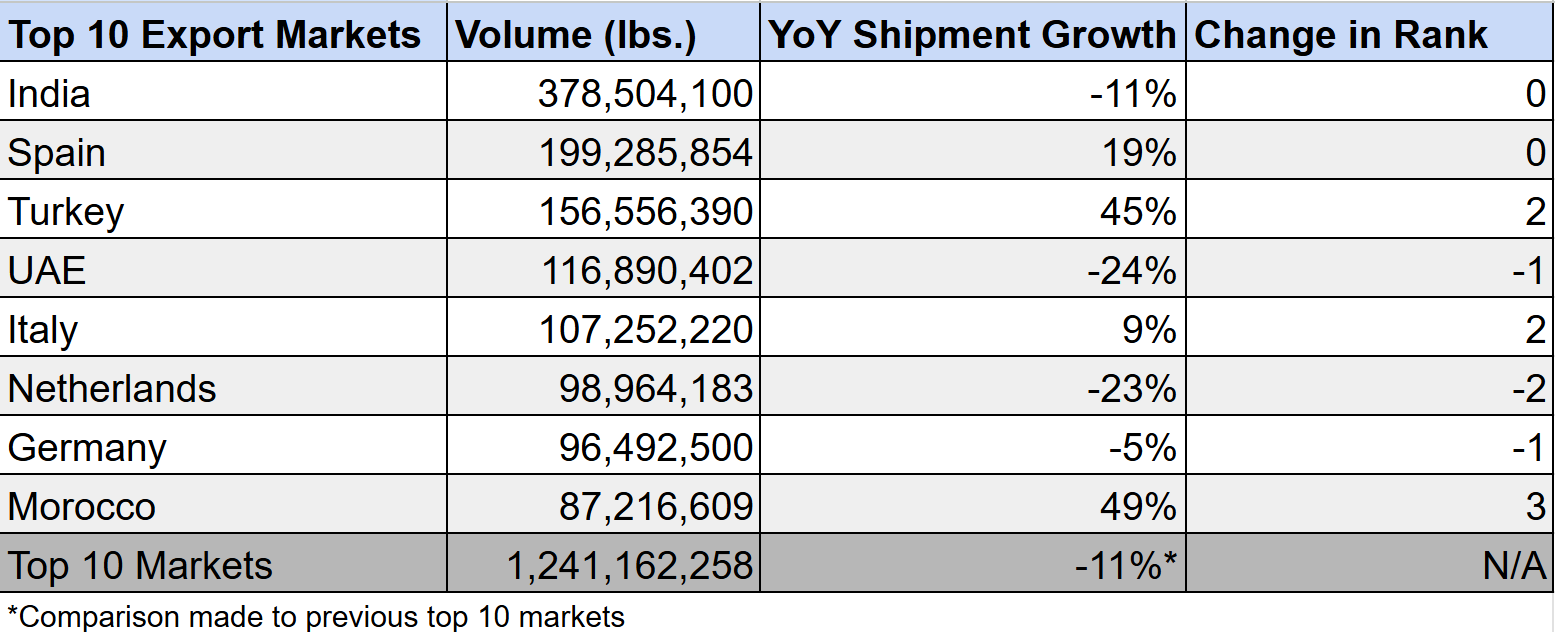
Shipment volume to India fell -11% YoY as India imported its smallest annual volume since the 2022/23 crop year. This fell below our initial expectations entering the year, but sustaining shipment volumes at last year's levels faced several headwinds.
India began the crop year in a relative oversupplied scenario with ample inventories in local markets. At the time of the previous harvest kernel weight was fetching a premium over inshell equivalent. This encouraged growers to shell out product that may have otherwise been destined for the inshell market. Furthermore, Australian growers experienced significant rain during their harvest. By the middle of the crop year a supply shortage for inshell was beginning to materialize and the price spread between kernels and inshell equivalent began signaling a premium for inshell product. Inshell premiums have since reached $0.20-$0.25 or more in favor of inshell signaling that indeed inventories had become constrained.
India's buyers and traders have also been under constant pressure, including changes to taxation policies and currency dynamics. As general commodity prices have risen, which the premium for inshell only compounded, buyers reacted with caution working nearly exclusively hand-to-mouth. The reluctance to take long positions and subsequent reduction in local inventories have pushed local trading markets to command significant premiums over market rates from California.
This paints a picture of an Indian market that is severely undersupplied. To add to demand pressures, buyers need to quickly move to purchase for the first of two Diwali seasons that will need to be supplied out of the up coming crop. With harvest running 7-10 days ahead of schedule, inshell supplies should begin to hit handler inventories in earnest shortly, but with such pent up demand from India, there is real concern about the capacity to service the demand in full. And if demand from India ties up significant industry throughput capacity, this could put pressure on commodity prices more broadly.
China/Southeast Asia
We have touched on China and its influence on Southeast Asian markets in our reports, most recently in our June Market Report. The economic headwinds pushing against direct shipments of almonds to China are nothing new at this point. The key take away for the 2025/26 crop year is that Inshell shipments into China are the most recent casualty, dropping from 21 million pounds last year to just over 1 million this year. While inshell shipments to Southeast Asian markets grew by +170%, the increase was just over 12 million pounds and well short of the -20 million pound decline in direct shipments.
It would be reasonable to inquire if perhaps some of that inshell volume may have been supplanted by kernel shipments. In fact, kernel volume directly into China actually grew by 2.4 million pounds (+8%) and kernel volume across Southeast Asia grew by more than 13.8 million pounds (+14.9%). Unfortunately suggesting kernels supplanted inshell would be an insufficient conclusion. Kernels do not represent a reasonable alternative for products utilizing inshell and China's supply chain is significantly more muddled than most other markets with other growing regions, like Australia, able to charge a premium for direct shipments to China while still representing an economically advantageous option. The reality is that a significant portion of Chinese demand is going to be satisfied by suppliers outside of California.
But we're not entirely blind to Chinese needs either. China has real need and we're likely to continue to see the continued development of the value added markets, especially for inshell products. Our sales team reports a significant increase in inquires from China and value-add facilities in markets that serve China for inshell product. With Australia suffering a wet harvest, quality inshell product from that region is significantly restrained and Chinese buyers are having to explore secondary options, including directly importing from California.
In the first half of the crop year, we're expecting inshell shipments to China and value add markets to see a sizable lift. Thereafter the reality for the Chinese market is one that has been the norm for quite some time, and that is a consumer market in China that represents tantalizing growth opportunity but economic and political realities that make it difficult to fully actualize the opportunity.
Middle East
Shipments to the Middle East grew +3% on the year. Turkey catches the headlines surpassing the UAE as the region’s largest importer, growing at +45% on the year. Conversely the UAE declined -24%. As we had previously reported, the volume shift from the UAE to Turkey has largely been driven by disruptions in the Strait of Hormuz with Turkey being well positioned to capitalize on its emergence as a viable regional trading hub. Taken together, volume to the UAE and Turkey is up +4.9%. Elsewhere, Saudi Arabia was down -12% on the year also seeing impacts from disruptions in the region, and Israel was a real bright spot, more than doubling its imports of almonds from a year ago and topping 17 million pounds.
Pakistan is a market we highlighted previously and ended the year up +403%, importing 37.7 million pounds. But what might appear as incredible market growth at first glance would be an entirely incomplete assessment. The shipment growth we observe in the Position Report is being driven by supply chain disruptions. Markets in the UAE can not currently supply markets the way that they had prior to war in the region and the disruptions in the Strait of Hormuz. This includes product destined for Pakistan, and likely Iran, as Pakistan and Iran share a boarder and Pakistan could be acting as a transshipment destination. the two share a boarder. in the way that it once was able.
Because Pakistan imported a majority of its needs through UAE markets and transshipment volumes are difficult to discern, it’s impossible for us to infer if Pakistan is indeed seeing demand growth. But that doesn’t mean that growth isn’t happening, at least from a broader regional context. If we look at volumes to the Middle East and Pakistan in combination, we see that collectively growth stands at +11.7%. This is significantly higher than the +3% growth rate we otherwise see from the Middle East. So while it is difficult to understand which market(s) may be driving the growth, we need to understand that shipments historically connected to the Middle East are growing at a much faster rate than might be immediately clear. This is important as we look ahead to where potential demand-side pressures may materialize in the year ahead and the reality is the markets served by the Middle East do continue to experience strong growth realities.
Western Europe
Collectively, imports to Western Europe markets grew +3% from a year ago. Not all individual markets enjoyed growth however. Spain, as the largest importer, saw some of the largest gains, growing +19% for the year. Last year’s number two and three markets both saw declines with the Netherlands off -23% and Germany off -5% slipping a spot each in the ranking to third and fourth respectively. The title of the second largest Western Europe market by volume now belongs to Italy after growing +9% on the year. Maintaining its rank as the fifth largest market, the UK grew +6%.
Looking ahead to the new crop year, Western Europe markets remain an important established market for California almonds. To begin the season, these markets will continue to rely on California for their preferred STD5 specifications with Australian supplies being impacted by water damage and rendering much of their inventory unusable for EU needs. This should keep demand strong, at least through the first half of the crop year.
Top 10 Markets
One last little take away before we move on from export markets. Collectively, volume going to the ten largest export markets on the crop year fell -11% YoY. In a year where shipment volume on net was essentially flat, this should highlight the growing strength and importance of the developing and emerging markets in driving demand for California almonds, especially when we see large yearly volume fluctuations in nearly all of the current top 10 markets. This shows the relative strength of global markets and widespread global demand for California almonds.
It's a New Season
The first truck loads of almonds have already come off the fields with many more to come. Harvest timing is well ahead of last year and recent hot weather has many expecting a condensed harvest season. Initial reports from growers are of disappointing kernel size and oversized hulls. If smaller than expected kernels prove to be a consistent finding, this would suppress yields, while oversized hulls could slow processing down reducing throughput for early season inventories even with an earlier harvest. That said, it is far too early to make any real predictions. Stressed orchards are often what is ready for harvest first and initial loads represent a small sample size and we do expect better results as harvest gets underway in earnest. Time will tell though, and the August report will give us our next opportunity to take a broader perspective and contextualize trends.
But there are real risks to supply constraints materializing. While the industry lacked an Objective Forecast this year, industry sentiment has been hedging on the softer side of the 2.7 billion pound Subjective Forecast with several large almond processors publishing proprietary forecasts below this figure. Early season concerns of smaller kernel sizes does nothing to counter the narrative of a lighter crop.
The carry forward heading into the new crop year also needs to be considered. As it stands, available inventory is -4% below levels last year. A full accounting of inedible loss still needs to be calculated before we have our carry forward figure, but as it stands there is high probability that the carry forward figure will fall below that of a year ago as the Position Report shows inedible running well above the 2% estimate that is used to calculate available inventory. We’re not expecting an especially large reduction in the calculated carry forward figure, but it’s another example of down-side risk being significantly higher than any possible boost to annual supplies and should be considered as we look ahead.
Market Summary
We’re bullish, and frankly generally have been since the fall. It's hard to be otherwise. Prices have been on a general upward trajectory and have jumped 10% or more just within the last week and are now at, or near, 10-year highs. Such large and rapid price swings can give both buyers and sellers pause; but, fundamentally none of the underlying conditions pushing up prices have subsided. In fact they may have only increased.
On the demand side, shipments have continued to keep up as prices have risen. India by itself is the giant in the room. India is empty and the first of two Diwali seasons set to come out of this upcoming crop needs coverage immediately.
If there were no other demand pressures, we'd still caution for bullish conditions, but this isn't the only demand signal. Disruptions in the Middle East have not dampened demand in that region and growth signals persist. China has found supply chain work arounds through Southeast Asia. And Western Europe, while rebalancing within individual markets is likely, on the whole has continued to show its maturity and stability even as local production capacity has increased. At least for the moment, California also remains the only viable supply option for it's STD5 product with rain damage in Australian product making it unsuitable for European needs. Furthermore, while the US domestic market has fallen from its high two years ago, it has stabilized, effectively cutting off a source of additional pounds that could be available for other markets as we move ahead into the new crop year.
Collectively, global markets are in a scenario when supplies from California have effectively made shipment growth impossible unless the upcoming harvest can provide an increase to supply. But let’s say hypothetically supply comes in at 2.6 billion pounds. Where would the industry cut 100 million pounds of shipments over last year's shipment volume while supplying India with a second Diwali season, and keeping up with growth in the Middle East, and, and… You get the point. Harvest yields are going to be the primary focus through harvest with both buyers and sellers looking for any signs suggesting a stronger or lighter yield.