
January 2026 Almond Market Report
Per the January 2026 Position Report, California handlers shipped 206 million pounds during the month of January. On net, shipments were off -9.9% YoY. Export shipments fell -7.1% YoY and domestic shipments continued to come within a narrow range near 50 million pounds per month with 51 million shipped in January. For the crop year, net shipments are off -7%.
Crop Receipts continue to validate the conclusion that crop size will be very similar to last year, off just -1.4% YoY. With remaining stockpiles at huller and sheller operations effectively depleted, any further anxiety around crop size should be gone.
Purchasing activity during January was particularly strong with Handlers adding over 298 million pounds of business to their books in January. To illustrate just how unusual this level of monthly purchasing is, California handlers have met or exceeded 300 million pounds of monthly contracts just three times since the 2015/16 crop year when excluding May’s figures that aggregate forward crop commitments. The impact of the accelerated buying pace pushed total committed shipments from a -11.6% YoY figure in December to +2.9% in January. Export markets were the key driver of the frenzied buying, flipping a -13.9% YoY commitment figure to +16.0%.
Bloom
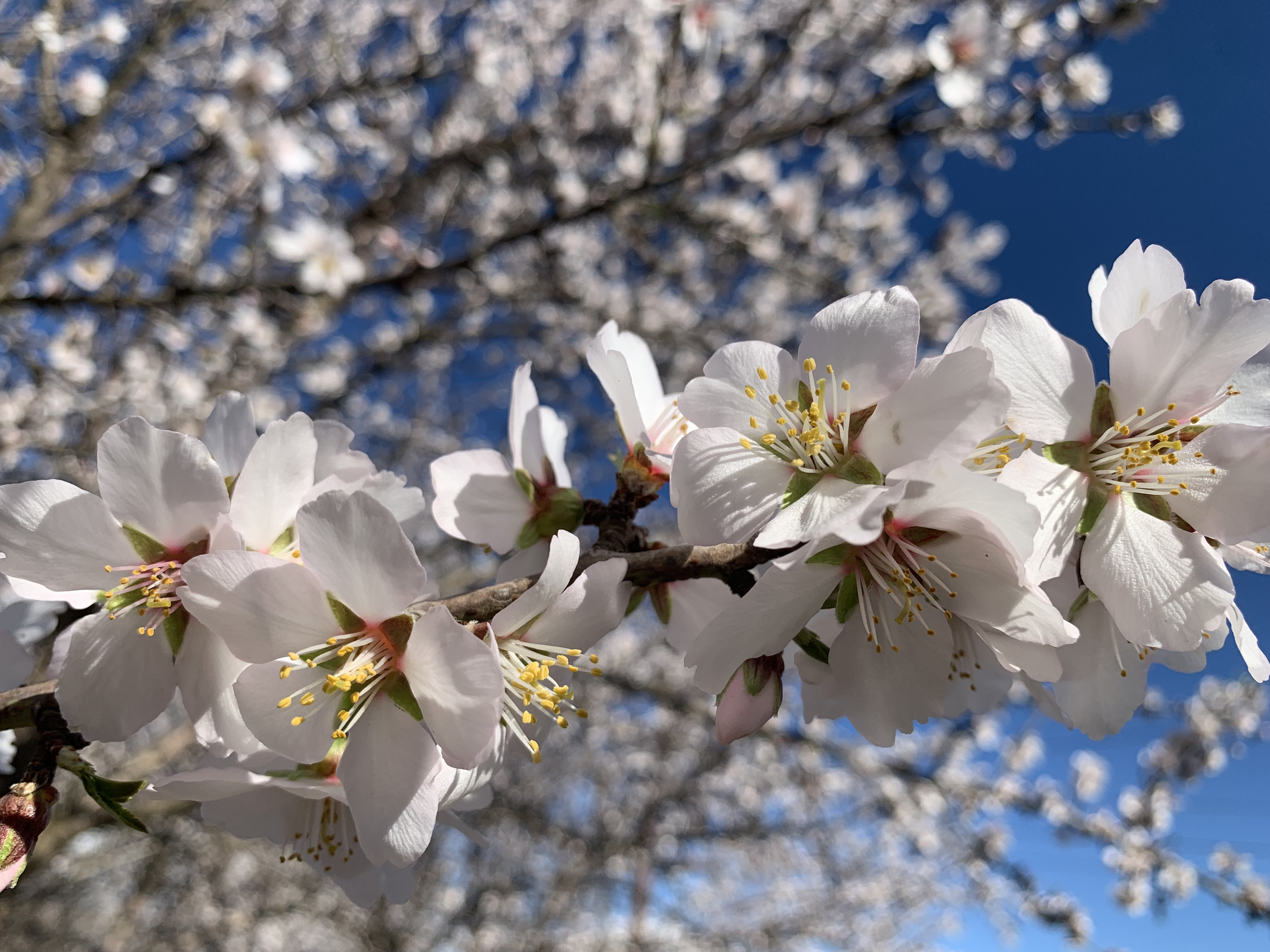
The California almond bloom is just gearing up with early varieties already beginning. California experienced a particularly dry and warm January across much of the state; however fog continued to be persistent at times in areas of the valley. Generally dry orchards however have allowed plenty of access for growers to perform pre-bloom maintenance and those utilizing cover crops have had good weather to promote growth and blossoms to support early arriving bees.
Wet and unsettled weather is forecast to return to California as we enter mid-February. There is hope that these weather systems will be colder and aid in additional snow accumulation in the mountains that feed summer runoff into California reservoirs. However cold and wet weather can present some challenges for almond growers during bloom with storms knocking off blossoms, limiting bee flight hours, and raising disease pressures. How much the future weather may impact the almond bloom will be something that we will continue to monitor as we head into spring.
Market Review
India continued its strong purchasing pattern after a slow start to the year and imported nearly 39 million pounds in January. On the crop year, India is now pacing a -12% growth rate. Our sales team continues to assess this market as rebalancing with strong needs within local supply chains. We expect to continue to see strong import figures next month. However, we maintain our warnings that both elevated levels of defects and serious damage from a wet harvest and a shifting of some supplies away from inshell could create a tight inshell market as we near summer.
South East Asia continues to see growth in response to shifting Chinese supply chains. Almond shipments into China are down -59% on the crop year. Meanwhile shipments into SE Asian markets are up +45%. Taken in aggregate, shipments to SE Asian and China are effectively flat, down less that -1%. Vietnam (+65%), Thailand (+17%), Malaysia (+53%), and Indonesia (+25%) continue to be the beneficiaries of the changing supply chain needs of China. Vietnam’s growth is particularly notable having now exceeded 47 million pounds for the crop year.
Western Europe took a bit of a breather in January importing -17.9% fewer almonds in January than a year ago. On the crop year, the region is off just -3%. Western Europe's four largest markets all imported fewer almonds in January than a year ago, but the two largest, Spain and Italy, both boast +13% growth rates for the crop year. Belgium has continued to experience significant growth, again importing significantly more volume than it did a year ago in January. The +68% growth rate for the crop year has firmly positioned Belgium ahead of France as the 6th largest market in the region.
The Middle East had a strong January importing +28.9% more almonds than it did a year ago. The region is now up +4% on the crop year. Turkey continued its role as a driver of growth in the region and has now top 80 million pounds of imports on the crop year and is growing at a rate of +17%. The UAE, long the region’s top importer, is also in growth territory, but significantly more modest at +2% for the crop year. The UAE's net imports of 87 million pounds on the crop year illustrate both its own strength, but also Turkey’s remarkable growth. As the region continues to mature, we may see some periodic shifts in the demand cycle and rebalancing. As the season progresses, this market may also experience tightening supplies associated with quality issues from a wet harvest; but overall, the Middle East continues to be poised as a consumption engine for California almonds.
Morocco took a relative break in January. It ended December up +41% on the crop year. After January, the growth rate has fallen to +24%. This is still a significant growth rate for a market that has the highest per capita consumption rate of almonds in the world. Some additional shipment volatility may be in store, but we see this market continuing to value almonds.
Balanced Markets
We continue to interpret current market conditions as relatively balanced. Yield uncertainty that lingered through the New Year had suppressed some buying with both handlers and importers being cautious about potential large market swings. With the publication of the January Position Report, clarity has returned regarding crop size. With this clarity, both buyers and sellers have been more willing to conduct business resulting in one of the busiest transaction months on record.
As markets continue to adjust to some forward market stability, some markets that had been operating hand-to-mouth may begin looking for opportunities to buy into some supply chain flexibility, either by bringing in additional loads or by entering into future-oriented contracts. This could have some interesting market impacts. For example, should monthly contracts continue to exceed shipment volumes in February, this would only reduce the available inventory left to sell. In turn, this could put added pressure on prompt shipments later in the season.
The industry will also be looking to forward monthly shipment volumes to assess the health of the market. As such, it's important to benchmark what a healthy shipment volume might look like. Last year, handlers added approximately 50 million pounds in crop receipts between February and July. Assuming a similar level, total new crop receipts for the current year would total 2.675 billion pounds this crop year. Using the current rate of rejects of -2.65%, and adding in the previous carry forward, total marketable supply for the year would come to 3.02 billion pounds. Assuming a carry forward of 500 million pounds, annual shipment volumes for the year would need to total 2.52 billion pounds. Subtracting the current volume already shipped, California handlers would be projected to sell roughly 1.243 billion pounds between now and the end of the crop year (July 31st). On a per month basis, this is just above 207 million pounds over the remaining six months of the crop year.
While eventual figures are yet to be seen, it's important to note that historically a carry forward that represents 20% of the annual shipment volume represents a balanced budget. In this projection, 500 million in carry forward on 2.52 billion pounds of shipments is right at this balanced stock-to-use ratio.
This makes this both a reasonable target and a very achievable one for California Handlers. Through the first six months of the crop year, export markets have averaged almost 164 million pounds per month. As we explored last month, domestic markets have settled into a narrow buying band averaging 50 million pounds per month. The sum of those averages comes to 214 million pounds, slightly above the 207 needed to end the year in a balanced manner. So don't let the negative YoY shipment numbers fool you. California Handlers will not ship as much as last year and that reality is supply driven, not a result of softened demand.
In either case, the torrid purchasing seen in January illustrates that there remains strong demand for California almonds. Handlers will be comfortable targeting a carry forward that provides flexibility through the transition. Purchasing activity in February is likely to be the primary driver of markets short term with focus shifting to the almond bloom for early signs of potential for future harvest.